Maggie
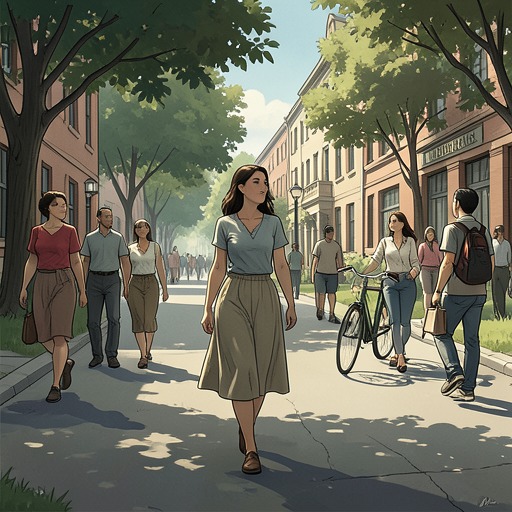
Along for the RideMaggie is one of Auden’s first important friends in Colby, joining sharp practical judgment to a history of BMX riding and an appetite for experiences beyond careful planning. She has known romantic disappointment, feels pressure from her mother about college, and is preparing for a future at Defriese University; yet she is also willing to return to the jumps, help Auden learn to ride, and show up when Auden seems lonely. Her role is not simply to welcome Auden into a new social circle: through concrete acts of patience and companionship, Maggie helps make trying again feel possible.
Identity and Introduction
Maggie first appears in a painful social moment. Leah and Esther tell her that Jake hooked up with another girl at the Tip, and Maggie’s startled response makes the news land as a personal blow rather than casual gossip. Soon afterward, she asks Auden whether she really likes him, stopping and taking a breath before asking for an honest answer. Auden says he means nothing to her. Maggie holds Auden’s gaze, then hands her the checkbook and thanks her. The exchange establishes both the strain surrounding Jake and Maggie’s directness: she wants clarity, but she does not prolong the confrontation once she has heard Auden’s answer.
Maggie is already part of a close-knit group with Leah and Esther when Auden begins working at Clementine’s. Their presence at the register makes Auden feel as though she is approaching a group that has already judged her. Maggie tells Leah that Auden will be doing the books because Heidi needs someone since the baby arrived. Although Maggie’s eyes remain on Auden, she flushes and busies herself with papers when Auden looks back. The scene suggests a friendship still taking shape, marked at first by self-consciousness as well as practical cooperation.
Skills, Work, and Ambition
Maggie’s competence is not confined to social intuition. When Auden sees her handle financial matters at the shop, she asks how Maggie learned so much. Maggie explains that she acquired the knowledge during her riding years: her mother did not support the hobby, so Maggie had to finance her bikes and equipment herself. Her ability to manage money grew out of a desire to keep riding despite limited support. The explanation gives her practical expertise a personal history; it is evidence of the independence she developed around an activity she valued.
That riding history is visible at the jump park. Auden first sees Maggie alone in the bleachers, looking toward the ramps while Adam and Wallace wait below with their bikes. Maggie pulls her dark curls back, takes a helmet from her bag, and heads down to them. Adam gets off his bike and offers it to her. She puts on the helmet, listens to him, and starts her run. She clears the jumps with increasing height, landing smoothly and returning to the boys, where Wallace offers her a Pringle. Auden had not expected this ease or skill. Maggie’s apparent distance from the action gives way to the confidence of someone who knows the course and can ride it well.
Maggie also speaks for a different way of approaching uncertainty. When Auden questions the group’s attention to stores, snacks, and small choices, Esther explains that they stop for supplies because they never know what may happen; Maggie adds that the store-going comes first and the adventure follows. Auden, who has been accustomed to deciding what is necessary, finds herself buying two chocolate cupcakes despite judging them extraneous. Maggie’s account turns their shopping ritual into preparation for the unplanned: a small but telling counterpoint to Auden’s habit of treating spontaneity as waste.
Friendship with Auden
Maggie’s friendship with Auden develops through both ordinary conversation and attentive acts. On the beach, as darkness falls and the families and groups gradually leave, Auden sits alone watching the shore. Maggie approaches with her bag over her shoulder and asks whether Auden is all right, noting that she seemed sad when she left. Auden remembers her mother’s dismissive judgment of Maggie and of the things associated with her, but recognizes that she is now within the very category she once tried to avoid. Maggie’s company feels welcome. Her approach does not demand an explanation; it interrupts Auden’s isolation and makes it possible for her to accept company without first resolving everything she feels.
The two also share intellectual and personal exchanges. When Belissa Norwood asks about Auden’s name, Maggie observes that Belissa is unlikely to be interested in the life of the modern poet Auden was named for. Maggie has written her senior thesis on loss in his poems, and she says the work helped her get into Defriese University. The moment surprises Auden: Maggie’s easy familiarity with the subject rests on serious study, not merely a passing acquaintance with the name. Later, Maggie describes her mother’s insistence that she choose a college roommate quickly so their linens can be coordinated. She recognizes the absurdity of the demand while also reporting her mother’s anxiety that anything short of a perfect college experience would be a tragedy. The parallel between their mothers’ expectations gives Auden and Maggie common ground without making their circumstances identical.
Teaching, Change, and Relationships
When Auden decides to learn to ride, Maggie becomes her patient instructor. At the clearing by the jump park, she picks up the fallen bicycle, stands it upright, and tells Auden to try again. Auden repeatedly panics, wobbles, and falls; on one attempt she travels about forty yards only because Maggie is holding the back of the seat, then veers into bushes when Maggie lets go. Maggie stays with the process rather than treating the first failure as a verdict. For the following week, they meet almost every morning after Auden picks up two coffees at Beach Beans. They begin with assisted riding, with Maggie holding the seat, then progress to short stretches in which she releases her grip but runs behind. As Auden improves her balance and pedaling, the intervals grow longer. The lessons remain imperfect—Auden still falls and has scabs on both knees—but the change from that first morning is tangible.
Maggie’s own prospects also begin to shift. When Auden and Adam are looking through prom photographs for the Beach Bash, Maggie appears in the doorway wearing flip-flops and jeans, recognizes the pictures, and recalls Leah’s date from junior year. Later, when Leah warns her not to say she is going with Jake Stock, Maggie blushes and says that Adam asked her. Leah and Esther respond with delighted surprise, saying that he has finally found the nerve. The exchange marks a contrast with the earlier news about Jake: Maggie’s social life is not defined by that hurt, and a new invitation has opened a possibility with Adam. The scene does not establish what follows, but it shows her friends recognizing the significance of his asking.
By the end of the evidence presented, Maggie remains an active presence in Auden’s daily life and looks ahead to Colby for the grand reopening, while passing along that Adam has sent Auden a T-shirt. Her character is built from continuities rather than a single transformation: the rider who once financed her own equipment can teach someone else to balance; the friend who asks for painful honesty can later offer companionship without pressure; and the student facing her mother’s elaborate college expectations still makes room for adventure. Maggie’s practical help gives Auden’s attempts a human structure—coffee, a meeting place, a hand at the back of the seat, and the patience to let go by degrees.